





American Companies in Uzbekistan
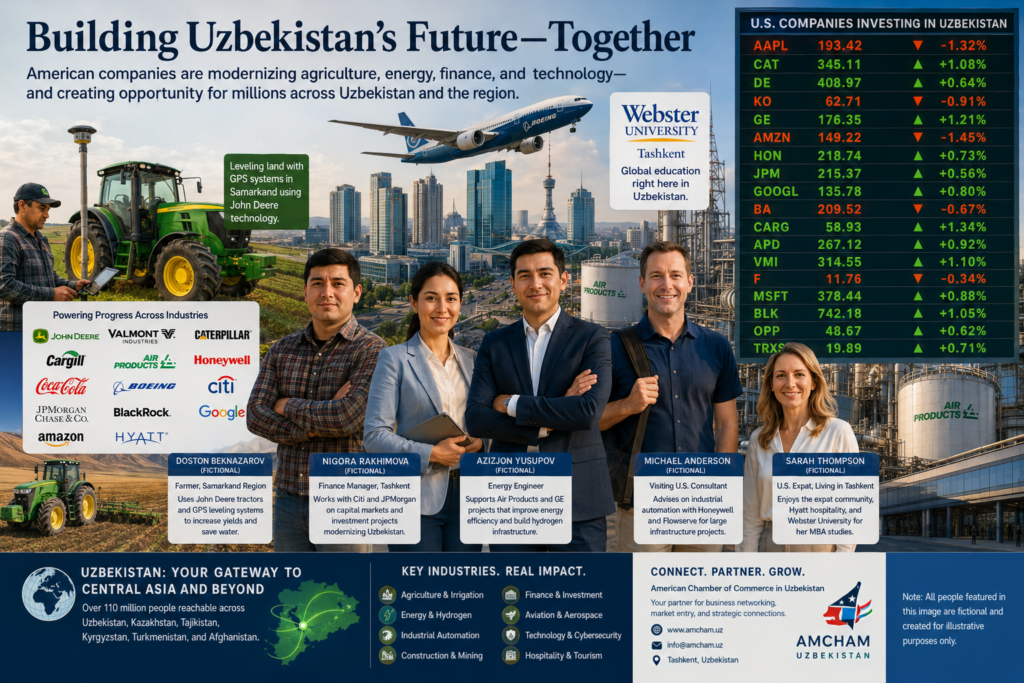
By UZDiaspora Editorial Desk — 2026 Economic Feature
The Morning Rush in a Changing Uzbekistan
At 7:10 AM in Tashkent, traffic already moves heavily along Amir Temur Avenue. White Chevrolet sedans weave through buses, construction trucks, delivery vans, and taxis carrying office workers toward the city center. Inside one café near the financial district, five very different people begin their day.
Dilshod, a local agricultural engineer from Jizzakh, checks irrigation monitoring data on his phone before traveling to a cotton and soybean project outside the city.
Madina, a cybersecurity student at Webster University in Tashkent, prepares for her internship interview with an international IT contractor.
Aziza, an accountant working with a logistics firm, reviews currency exchange movements and follows American stock market futures before local business hours begin.
Michael, a visiting American investor from Texas, is meeting Uzbek partners to discuss agricultural storage and grain processing opportunities.
And Sarah, an American expat originally from Colorado who has lived in Uzbekistan for four years, orders coffee before joining an online conference call with a cloud-services client operating across Central Asia.
Five people. Five completely different backgrounds. One rapidly modernizing economy.
What connects all of them is something many people outside the region still do not fully understand:
American companies are no longer simply “doing business” in Uzbekistan.
They are helping build systems.
From irrigation and aircraft to cybersecurity and finance, U.S. companies now play an increasingly visible role in Uzbekistan’s modernization story.
Uzbekistan Is Becoming a Regional Business Hub
For years, international investors often viewed Uzbekistan only through the lens of geography, cotton, or Soviet history.
That perception has changed.
Today, Uzbekistan is increasingly viewed as one of Central Asia’s most strategically positioned economies.
The country’s population has surpassed 37 million people, making it the largest consumer market in Central Asia. More importantly, Uzbekistan borders every other Central Asian republic and maintains critical transport access routes toward Afghanistan.
When international companies establish operations in Uzbekistan, they are not entering a market of 37 million alone.
They are positioning themselves near a regional economic corridor exceeding 110 million people.
| Regional Market | Population |
|---|---|
| Uzbekistan | 37 million |
| Kazakhstan | 19 million |
| Tajikistan | 10 million |
| Kyrgyzstan | 7 million |
| Turkmenistan | 6 million |
| Afghanistan | 40+ million |
This is one reason why approximately 336* American-capital enterprises now operate in Uzbekistan through subsidiaries, partnerships, representative offices, investment vehicles, and joint ventures.
Some are massive multinational corporations. Others are specialized consulting firms, engineering companies, IT contractors, agricultural investors, or logistics providers.
Together, they form part of an expanding commercial ecosystem centered largely in Tashkent.
The Companies Most People Already Know
Some American brands are already deeply familiar to ordinary Uzbek consumers.
Walk through Tashkent and you immediately notice Chevrolet vehicles dominating roads across the capital. The country’s automotive sector was heavily influenced by partnerships involving General Motors.
Inside supermarkets and restaurants, Coca-Cola products remain one of the most recognizable international consumer brands in Uzbekistan.
At the airport, Boeing aircraft continue supporting regional and international aviation routes.
In luxury hospitality, Hyatt and Hilton properties have become part of the city skyline and international business infrastructure.
Yet many of the most important American contributions are not directly visible to ordinary consumers.
They exist behind the scenes.
Inside industrial facilities. Inside databases. Inside irrigation systems. Inside cybersecurity networks. Inside power stations and logistics chains.
That is where the real transformation is occurring.
Agriculture: The Sector Quietly Undergoing a Revolution
Several years ago, much of Uzbekistan’s agricultural modernization discussion focused primarily on cotton.
Today the conversation is broader.
Water management, livestock feed, mechanization, irrigation efficiency, crop diversification, greenhouse systems, and food security have become major priorities.
This is where companies like John Deere, Valmont Industries, CNH Industrial, Cargill, Aviagen, and agricultural investment groups increasingly enter the picture.
Dilshod’s Story: From Manual Monitoring to Smart Irrigation
Dilshod remembers when his father’s generation depended heavily on manual observation for irrigation timing.
“People walked fields physically to estimate water conditions,” he explains.
Today, he works with farms using modern irrigation monitoring systems connected to centralized databases.
Valmont Industries, known globally for irrigation technology, has become part of broader efforts to improve agricultural water efficiency in Uzbekistan.
In a country where water management directly impacts economic stability, modern irrigation technology is not simply a convenience.
It is strategic infrastructure.
Smart irrigation systems can reduce waste, improve crop consistency, and help stabilize yields during difficult seasonal conditions.
Meanwhile, John Deere equipment and mechanized systems continue supporting modernization of large-scale farming operations.
For younger Uzbek agricultural specialists, this shift creates something equally important:
Technical career pathways.
Modern agriculture increasingly requires:
- Equipment diagnostics
- GPS-guided systems
- Maintenance databases
- Logistics planning
- Precision agriculture analysis
- Digital monitoring
- Supply-chain coordination
Agriculture today looks far closer to industrial systems management than traditional farming stereotypes.
The Soybean Opportunity Few People Discuss Publicly
One emerging opportunity attracting attention among agricultural analysts involves soybeans.
The United States remains one of the world’s largest soybean producers, while Uzbekistan’s livestock, poultry, and dairy sectors continue expanding.
Protein-rich feed demand is rising.
Domestic soybean production remains limited.
That creates a strategic alignment opportunity.
American exporters and agricultural suppliers increasingly view Central Asia as a long-term growth market for feed products, farming partnerships, and agricultural processing.
Michael, the visiting American investor from Texas, describes the opportunity carefully.
“People sometimes focus only on oil or minerals in emerging markets,” he says.
“But food systems and feed supply chains may become even more important over the next twenty years.”
For Uzbekistan, agricultural modernization is directly tied to food security, employment, and rural economic development.
For American agribusiness companies, it represents an emerging market still early in its growth cycle.
Energy and Industrial Infrastructure: The Invisible Backbone
Most people rarely think about industrial gases, flow-control systems, or refinery automation.
Yet without them, modern economies do not function efficiently.
Companies such as Air Products, Honeywell, General Electric, Flowserve, and Traxys participate in projects tied to industrial modernization, energy systems, gas processing, mining support, and infrastructure upgrades.
These sectors are less visible than hotels or restaurants, but they often involve some of the largest long-term investments.
Aziza’s Story: Following Markets from Tashkent
Every morning before work, Aziza opens several financial applications and checks global market movements.
Green and red stock charts move across her screen:
- BlackRock
- JPMorgan Chase
- Caterpillar
- Boeing
- Valmont Industries
- Coca-Cola
Some are up. Some are down.
She laughs while explaining that her father still thinks “stock markets are only for rich Americans.”
But Uzbekistan’s younger professionals increasingly follow international finance because global investment activity now directly affects local business opportunities.
Privatization efforts, sovereign investment management, infrastructure financing, and international banking cooperation are becoming part of Uzbekistan’s economic vocabulary.
Companies such as Citigroup, JPMorgan Chase, Franklin Templeton, BlackRock, and Oppenheimer-linked financial activity contribute to capital markets development and international financial integration.
This shift may seem abstract at first.
But eventually it affects ordinary people:
- access to financing
- business expansion
- pension systems
- investment climate
- employment growth
- startup funding
- currency stability
Modern economies increasingly operate through financial infrastructure as much as physical infrastructure.
Technology, Cybersecurity, and Cloud Systems
Uzbekistan’s technology sector continues expanding rapidly.
The country’s young population, multilingual workforce, and growing digital economy have attracted attention from technology firms and outsourcing operations.
Google services, Amazon cloud infrastructure, and cybersecurity technologies from Palo Alto Networks increasingly intersect with government modernization, financial systems, telecom infrastructure, and private business operations.
Meanwhile, IT outsourcing and staffing companies help connect Uzbek specialists with international projects.
Madina’s Story: Webster University and a New Career Path
Madina studies cybersecurity at Webster University in Tashkent.
For her generation, international education is no longer viewed as something that only exists abroad.
Webster University’s presence gives students access to American-style educational frameworks while remaining in Uzbekistan.
That matters.
Students can build technical skills locally while preparing for global employment markets.
Madina hopes to eventually specialize in cloud security and industrial cybersecurity systems.
“Ten years ago many people only imagined working for local offices,” she says.
“Now students think internationally from the beginning.”
Universities, certifications, English-language instruction, and digital training programs increasingly function as economic infrastructure themselves.
Modern economies depend on skilled workers just as much as roads or pipelines.
Construction, Mining, and Heavy Equipment
Infrastructure development remains one of the largest long-term sectors in Uzbekistan.
Roads, logistics facilities, industrial zones, warehouses, mining projects, and urban development all require large-scale machinery.
That is where companies like Caterpillar continue maintaining strong regional importance.
Mining operations and industrial construction rely heavily on durable heavy equipment capable of operating in demanding conditions.
For many younger Uzbek engineers, heavy industry no longer represents a stagnant Soviet-era image.
It increasingly overlaps with:
- GPS systems
- automated diagnostics
- supply-chain software
- maintenance analytics
- predictive equipment servicing
- digital inventory management
Even bulldozers now operate inside database ecosystems.
Aviation and International Connectivity
Few industries symbolize international integration more visibly than aviation.
Boeing aircraft remain central to Uzbekistan’s aviation modernization efforts and international route development.
Reliable aviation infrastructure impacts tourism, trade, labor mobility, and foreign investment.
As Central Asia becomes more connected economically, aviation will likely remain strategically important for both passenger movement and cargo logistics.
Emerging aerospace cooperation projects involving firms like Axiom Space also demonstrate how technological relationships between Uzbekistan and American companies continue evolving beyond traditional sectors.
Hospitality: More Than Hotels
International hotels often represent much more than tourism.
Properties such as Hyatt Regency Tashkent and Hilton Tashkent City function as business ecosystems.
Inside these hotels:
- investment meetings occur
- contracts are negotiated
- conferences are hosted
- international delegations stay
- startup events take place
- regional networking develops
Sarah’s Story: The American Expat Perspective
Sarah originally moved from Colorado to Uzbekistan for a temporary consulting assignment.
Four years later, she still lives in Tashkent.
She describes the biggest surprise this way:
“People outside the region often underestimate how international the business environment is becoming.”
Her daily life includes:
- remote cloud meetings
- Uzbek language practice
- local cafés
- expat business events
- regional travel
- partnerships with Central Asian clients
She explains that modern Uzbekistan increasingly attracts people who want exposure to emerging markets without some of the instability associated with other frontier regions.
For many expats, the country offers a combination of:
- affordability
- growing infrastructure
- educated workforce
- strategic location
- improving connectivity
- expanding international business activity
Databases: The Quiet Force Behind Modernization
One of the least visible — yet most important — contributions American companies bring involves structured operational systems.
Modern corporations depend heavily on databases.
Not just spreadsheets.
Integrated systems.
These systems track:
- maintenance records
- employee certifications
- equipment servicing
- supply chains
- irrigation performance
- logistics movement
- inventory levels
- safety compliance
- training records
- procurement systems
This matters enormously.
Because systems create predictability.
Predictability creates investment confidence.
And investment confidence creates long-term economic stability.
When Uzbek specialists learn these systems, they gain transferable international skills.
That may ultimately become one of the most valuable forms of economic development:
knowledge transfer.
Challenges Still Exist
Despite major progress, Uzbekistan still faces real challenges.
Serious investors understand this clearly.
Among the commonly discussed issues:
- regulatory complexity
- logistics bottlenecks
- infrastructure gaps
- currency movement concerns
- bureaucratic delays
- regional geopolitical risks
- transportation modernization needs
International businesses entering Uzbekistan often require patience, strong local partnerships, and long-term planning.
Yet many companies remain optimistic precisely because the market still sits relatively early in its development cycle.
For long-term investors, early-stage environments often offer the largest future upside.
Industry Snapshot: Major American Companies Operating in Uzbekistan
| Industry | Major Companies | Primary Role |
| Automotive | General Motors | Vehicle manufacturing and technology transfer |
| Agriculture | John Deere, Valmont Industries, CNH Industrial, Cargill, Aviagen | Farm modernization and irrigation |
| Energy | Air Products, Honeywell, GE, Flowserve | Industrial systems and power infrastructure |
| Finance | Citigroup, JPMorgan Chase, Franklin Templeton, BlackRock | Capital markets and investment systems |
| Technology | Google, Amazon, Palo Alto Networks | Digital infrastructure and cybersecurity |
| Construction & Mining | Caterpillar, Traxys | Heavy equipment and industrial operations |
| Aviation | Boeing, Axiom Space | Aviation modernization and aerospace cooperation |
| Hospitality | Hyatt, Hilton | Tourism and business infrastructure |
| Education | Webster University | International education and workforce training |
Where Companies and Investors Often Begin
One major institutional gateway for American businesses entering Uzbekistan remains the American Chamber of Commerce in Uzbekistan.
Organizations like AmCham help:
- connect foreign investors
- facilitate networking
- explain market conditions
- organize business events
- support partnerships
- provide market-entry guidance
As Uzbekistan’s economy continues integrating internationally, organizations that bridge local and foreign business communities will likely grow even more important.
Long-Term Outlook: Still Early in the Story
Uzbekistan’s economic relationship with American business remains in a relatively early phase.
That is precisely why many investors continue paying close attention.
The country combines:
- strategic geography
- a young workforce
- industrial modernization needs
- expanding consumer markets
- growing digital infrastructure
- agricultural potential
- regional connectivity
American companies are increasingly participating not only as suppliers, but as long-term operational partners.
Some help modernize irrigation systems. Others build financial infrastructure. Others support cybersecurity, aviation, logistics, agriculture, hospitality, or industrial operations.
Together, these systems form part of a larger transformation:
Uzbekistan evolving from a post-Soviet economy into a modern regional business platform.
And for many professionals, students, entrepreneurs, and members of the diaspora, the opportunity may only be beginning.
UZDiaspora.com continues tracking economic development, immigration, education, finance, and business trends connecting Central Asia with the United States and the broader international community.
The American Chamber of Commerce in Uzbekistan (AmCham Uzbekistan) is a business association that helps connect American companies, international investors, and local Uzbek businesses operating in Uzbekistan.
AmCham serves as a networking and advocacy platform where business leaders, investors, diplomats, and professionals discuss:
- trade and investment opportunities
- regulatory and business climate issues
- infrastructure and economic reforms
- partnerships between U.S. and Uzbek companies
- education, technology, agriculture, and industrial development
The organization regularly hosts:
- business forums
- investment discussions
- networking events
- industry presentations
- meetings with government and private-sector representatives
For many foreign companies entering Uzbekistan, AmCham functions as an important first point of contact for understanding the local business environment and building professional connections.
Official website:
https://www.amcham.uz
- “Some companies operate directly in Uzbekistan, while others work through regional offices, distributors, franchise partners, investment structures, or project-based operations.”
Industrial / Manufacturing / Energy
- General Motors
- Caterpillar
- John Deere
- Honeywell
- Boeing
- Air Products
- Cummins
- Halliburton
- Schlumberger
- Baker Hughes
- Emerson Electric
- GE Aerospace
- Westinghouse Electric Company
- Flowserve
- Xylem Inc.
Technology / IT / Telecom / Software
- Microsoft
- IBM
- Oracle
- Cisco
- Dell Technologies
- HP Inc.
- Intel
- NVIDIA
- Apple
- Amazon Web Services
- Meta
- Adobe
- EPAM Systems
- Cloudflare
- VMware
- Zoom Communications
- Salesforce
- ServiceNow
- Motorola Solutions
Finance / Banking / Payments
- Visa
- Mastercard
- Western Union
- MoneyGram
- JPMorgan Chase
- Citi
- Bank of America
- Morgan Stanley
- Goldman Sachs
- Franklin Templeton
Consumer Goods / Food / Beverage
- Coca-Cola
- PepsiCo
- Procter & Gamble
- Colgate-Palmolive
- Johnson & Johnson
- Kimberly-Clark
- Mondelez International
- Mars Incorporated
- Kraft Heinz
- Philip Morris International
- The Coca-Cola Company Uzbekistan bottling partners
- Amway
- Herbalife
- McCormick & Company
- Tupperware Brands
Hospitality / Food Chains / Retail
- Hilton Hotels & Resorts
- Hyatt Hotels Corporation
- Marriott International
- KFC
- Pizza Hut
- Papa John’s
- Baskin-Robbins
- Starbucks
- The Ritz-Carlton
- Wyndham Hotels & Resorts
Consulting / Legal / Accounting
- Deloitte
- PwC
- KPMG
- EY
- McKinsey & Company
- Boston Consulting Group
- Baker McKenzie
- White & Case
- Visa Consulting & Analytics
- Marsh McLennan
More companies later added to the list
- Sheladia Associates, Inc. – Multidisciplinary engineering, architecture, and international development consulting.
Logistics / Aviation / Transport
- FedEx
- UPS
- C.H. Robinson
- Expeditors International
- Boeing Global Services
Pharma / Healthcare
- Pfizer
- Abbott Laboratories
- Merck & Co.
- Bristol Myers Squibb
- Medtronic
- Johnson & Johnson MedTech
Education / NGOs / Development / Partnerships
- Coursera
- ETS TOEFL
- Pearson Education
- Creative Associates International
- Winrock International
- Chemonics International
- The Coca-Cola Foundation
- American Councils for International Education
- AmCham Uzbekistan